Industry
AI / Knowledge Systems / Generative Interfaces
Client
AI Product Prototype
Designing an AI-Native Interface for Navigating Complex Knowledge Systems
Move From Information Overload to Navigable Knowledge My Role
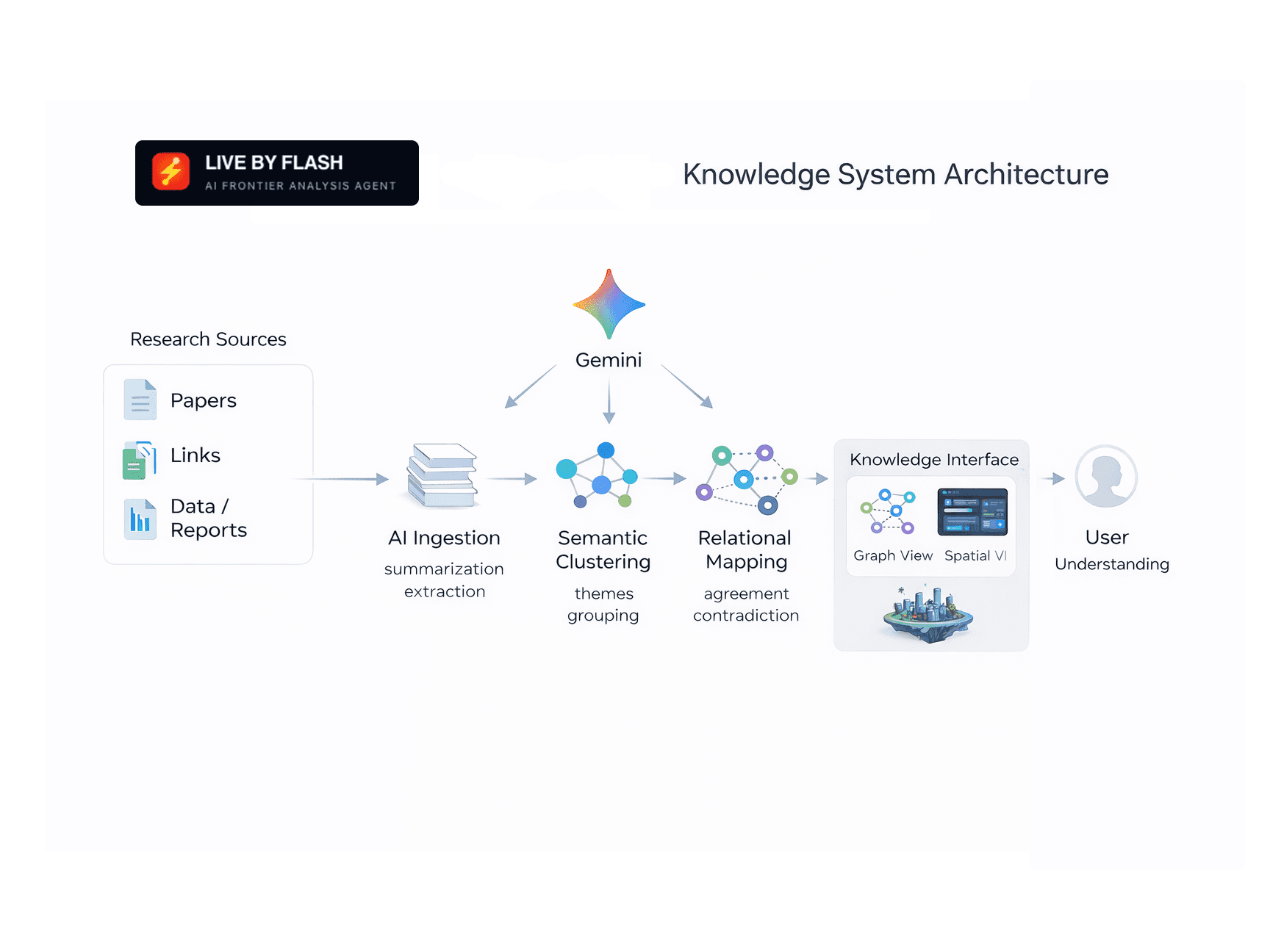
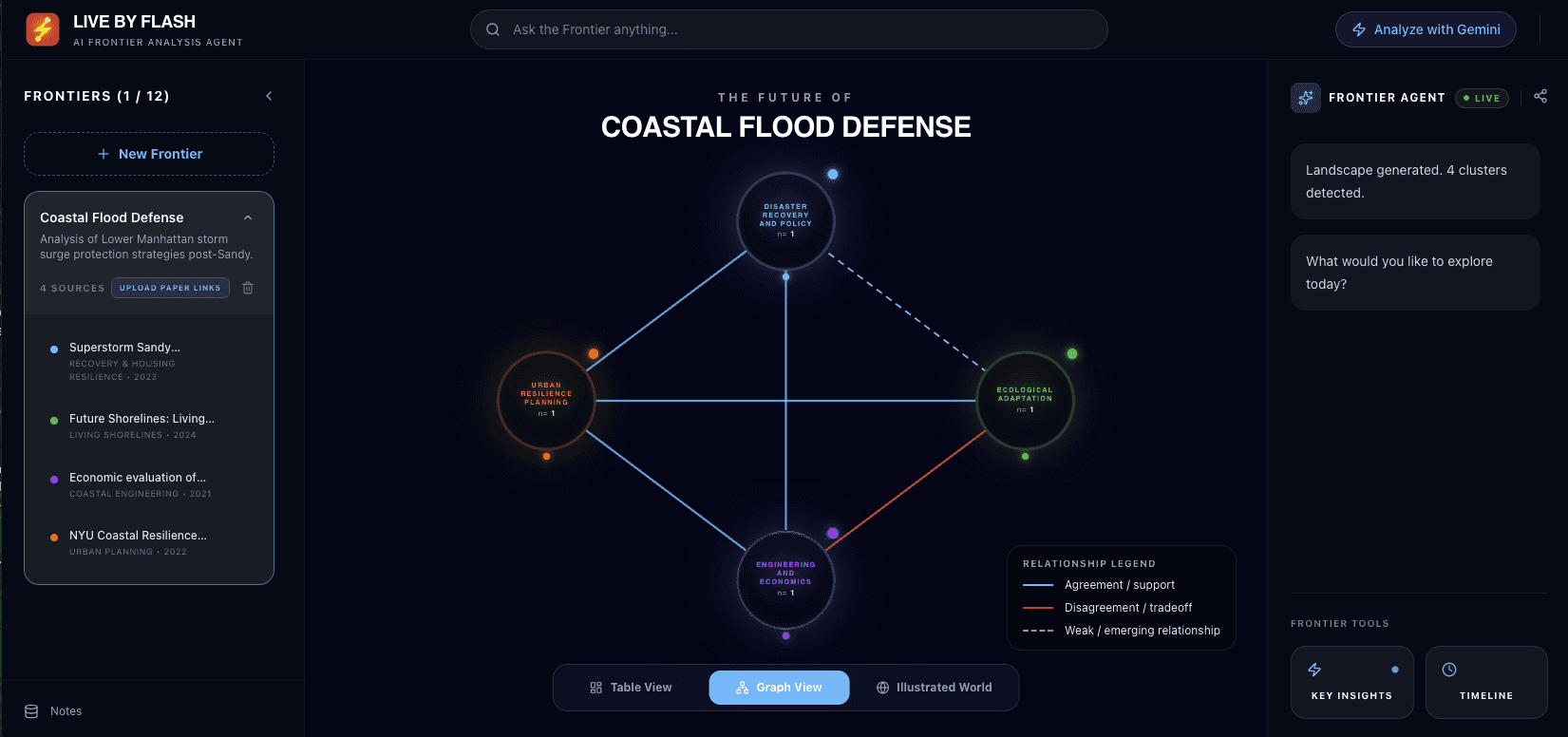
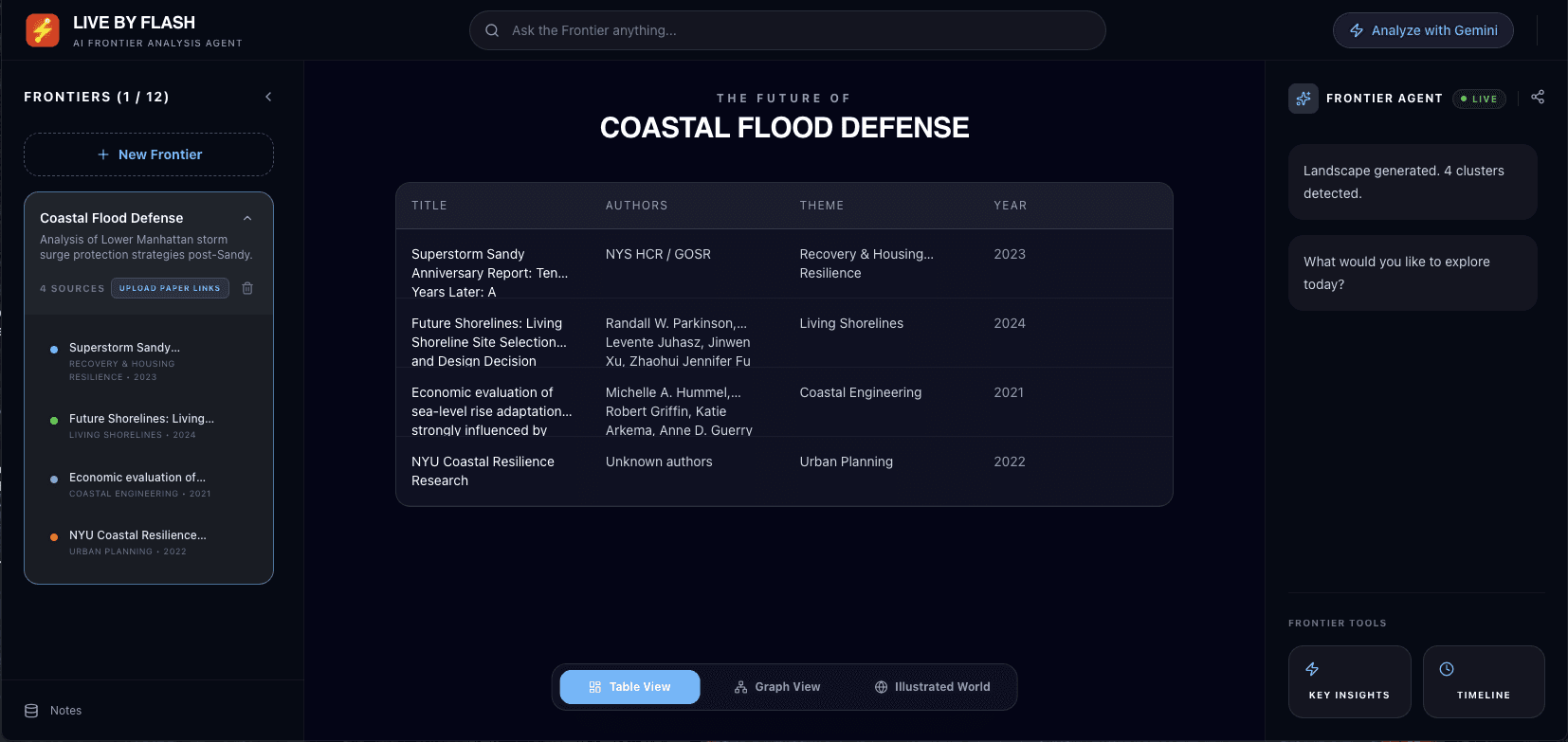
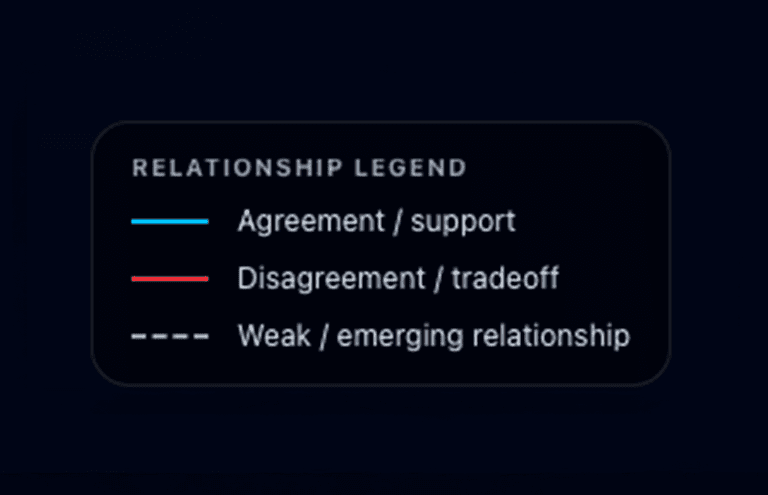
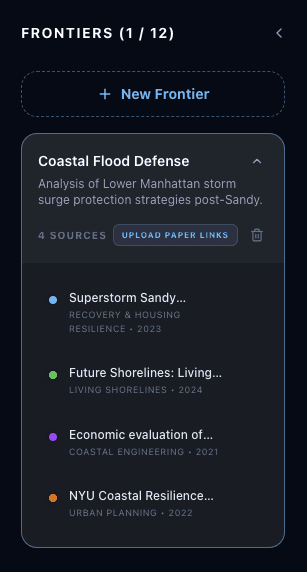
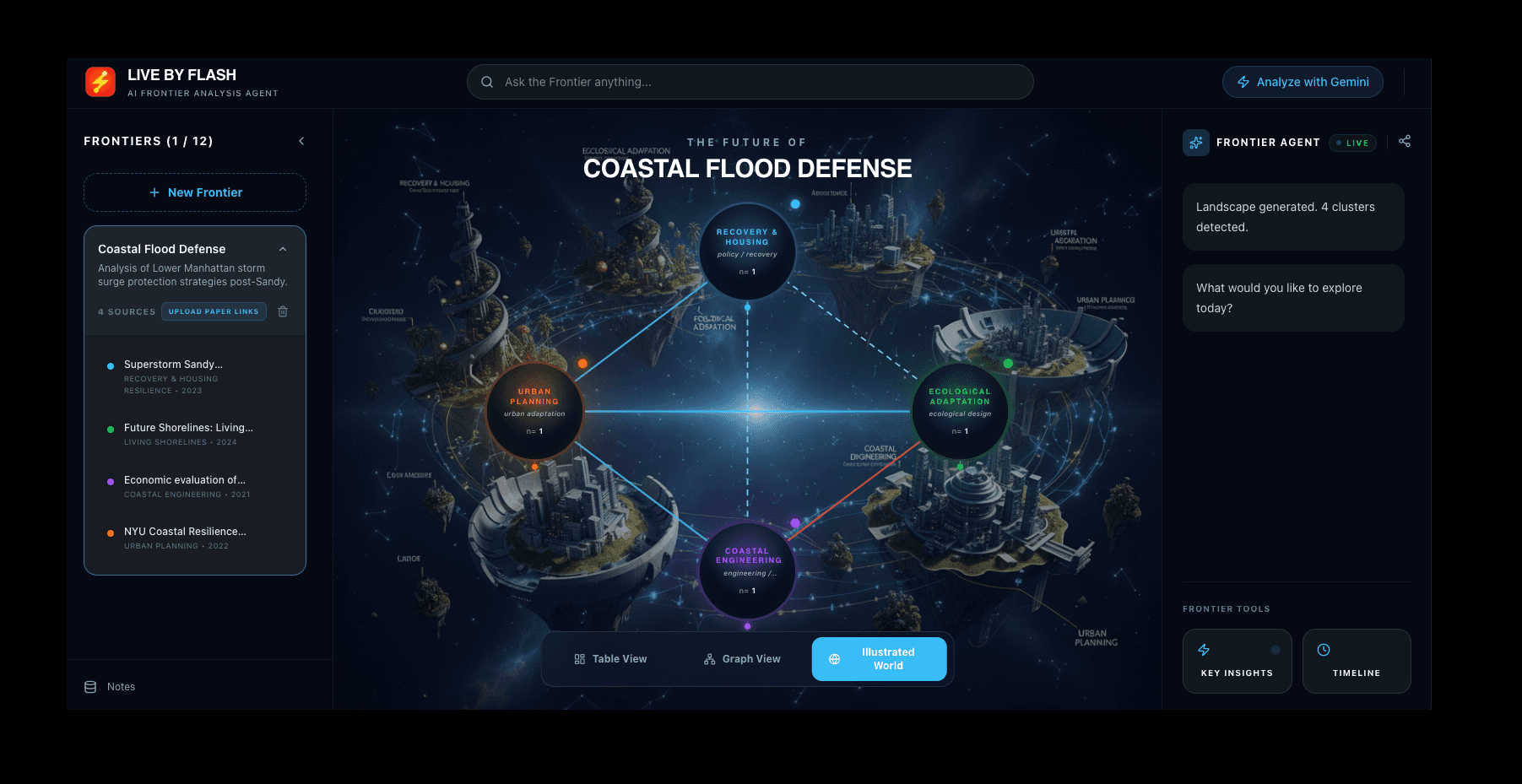
PROBLEM CONTEXT — As research output accelerates, understanding is no longer limited by access, but by synthesis. Scientific papers, policy reports, and technical literature exist as fragmented artifacts, making it difficult to see how ideas relate, conflict, or evolve over time. Traditional interfaces treat knowledge as isolated documents, forcing users to manually reconstruct the structure of a domain. This creates a gap between information retrieval and actual comprehension. CONCEPT OVERVIEW — Live by Flash is an AI-native research interface that transforms collections of sources into interactive knowledge systems. Rather than presenting results as linear summaries, the system uses Gemini to cluster research into conceptual groupings and map relationships between ideas — including agreement, contradiction, and thematic overlap. The interface shifts the model’s role from answer generation to structural reasoning, enabling users to explore a domain as a connected landscape rather than disorganized documents. The result is a multimodal system where visual context, semantic clustering, and conversational interaction work together to support deeper understanding. DESIGNING FOR PROBABILISTIC KNOWLEDGE SYSTEMS — Unlike deterministic interfaces, research interpretation operates in a probabilistic space where meaning emerges from relationships rather than single outputs. Live by Flash introduces a set of interaction principles to support this: • Cluster-Based Navigation: Research is organized into dynamic conceptual clusters, allowing users to understand the shape of a field before diving into individual sources. • Relational Visibility: Connections between clusters surface how ideas reinforce or contradict each other, exposing underlying debates and uncertainty. • Generative Spatial Context: AI-generated environments provide a visual scaffold for abstract knowledge, helping users orient themselves within complex domains. • Human-in-the-Loop Interpretation: The system augments expert reasoning by structuring information, while preserving human judgment as the final layer of interpretation. EXTENDING TO REAL-TIME & COLLABORATIVE SYSTEMS — While currently prototyped for static research sets, the architecture is designed to scale toward continuously evolving knowledge environments. • Live Knowledge Updating: Integration with real-time data sources enables frontiers to evolve dynamically as new research emerges. • Collaborative Exploration: Shared knowledge spaces allow teams to navigate and interpret research collectively, aligning understanding across disciplines. • Agent-Assisted Reasoning: The conversational layer supports guided exploration, helping users interrogate the structure of a domain without losing context.